Exclusive vs Parallel vs Inclusive Gateway in BPMN: What’s the Difference?
17-03-2026
13 min
When modeling business processes in BPMN, one of the most common questions is:
Which gateway should I use: Exclusive, Parallel, or Inclusive?
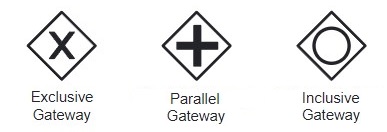
All three gateways control how a process splits and merges paths, but they behave very differently. Choosing the wrong one can cause incorrect process logic, deadlocks, or misleading diagrams.
In this guide, you’ll learn the exact difference between Exclusive, Parallel, and Inclusive gateways, when to use each one, and the typical modeling mistakes to avoid.
Key Takeaways
- Exclusive Gateway (XOR) – selects exactly one path from several alternatives.
- Parallel Gateway (AND) – activates all paths simultaneously.
- Inclusive Gateway (OR) – activates one or more paths depending on conditions.
- Exclusive gateways do not synchronize tokens when merging.
- Parallel gateways wait for all incoming tokens before continuing.
- Inclusive gateways wait only for the branches that were activated earlier.
In short:
| Gateway | Behavior | Typical Question |
|---|---|---|
| Exclusive (XOR) | One path only | "Which option should we choose?" |
| Parallel (AND) | All paths | "What tasks can happen simultaneously?" |
| Inclusive (OR) | One or more paths | "Which of these optional actions should we perform?" |
Why Gateways Matter in BPMN
Gateways control how the token moves through a process model. Without them, the process may produce uncontrolled flows, leading to unexpected execution order or duplicated Tasks.
In BPMN diagrams, gateways appear as diamonds and act as routing mechanisms that determine how the process branches and merges (more details: Messy BPMN: uncontrolled flows, conditional flows).
Choosing the right gateway ensures the model is:
- logically correct
- understandable for stakeholders
- executable by BPM engines
1. Exclusive Gateway (XOR): Choose One Path
The Exclusive Gateway represents a branching point where only one path can be taken (more details: Why are Exclusive and Parallel Gateways critical in BPMN?).
It is the most common gateway in BPMN.
How it works
When a token reaches the gateway:
- Conditions on outgoing flows are evaluated
- Only one condition should be true
- The token continues through the selected path
Example - Customer Order Discount Process
Business context: A retail company wants to automatically apply discounts for high-value orders.
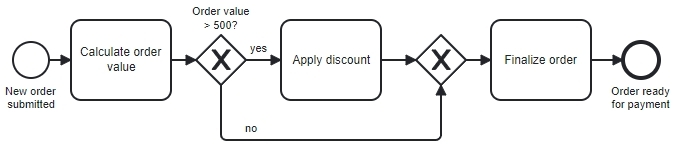
- If the order value exceeds 500 → Apply discount path.
- Otherwise → skip discount path.
Explanation: Only one path can be taken because an order cannot be both discounted and non-discounted at the same time.
Key characteristics
✔ Exactly one path is chosen
✔ Conditions must be mutually exclusive
✔ The merging version does not wait for other branches (more details: Do I need a merging Exclusive Gateway in BPMN?)
2. Parallel Gateway (AND): Execute Everything
A Parallel Gateway allows multiple activities to occur simultaneously.
Instead of choosing one path, the process creates multiple tokens and sends them through all outgoing flows.
How it works
When splitting:
- One token becomes multiple tokens
- Each token activates a different branch
When merging:
- The gateway waits for all tokens before continuing
Example - Project Approval Process
Business context: A company is launching a new project that requires multiple departmental approvals at the same time.
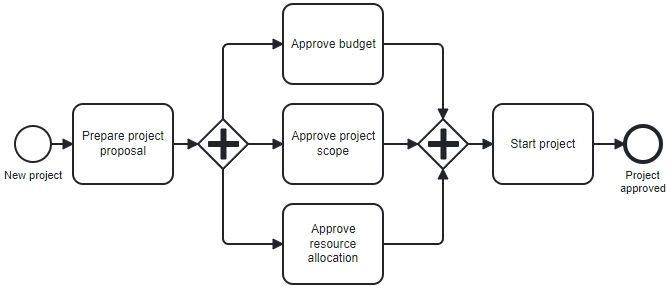
- Budget Approval – finance team checks funding availability
- Scope Approval – project management confirms deliverables and timeline
- Resources Approval – HR ensures staff and equipment are ready
Explanation: All approvals are needed simultaneously before the project can proceed.
Key characteristics
✔ All branches are executed
✔ The join waits for every active branch
✔ Used for parallel work
3. Inclusive Gateway (OR): One or More Paths
The Inclusive Gateway is a hybrid between Exclusive and Parallel gateways. It allows one, several, or all paths to be activated depending on conditions. (more details: Mysteries of the BPMN Inclusive Gateway)
How it works
When splitting:
- Each condition is evaluated
- Every true condition activates its path
When merging:
- The gateway waits only for the branches that were actually activated
Example - Customer Onboarding Notifications
Business context: An online service allows customers to choose how they want to receive onboarding communications.
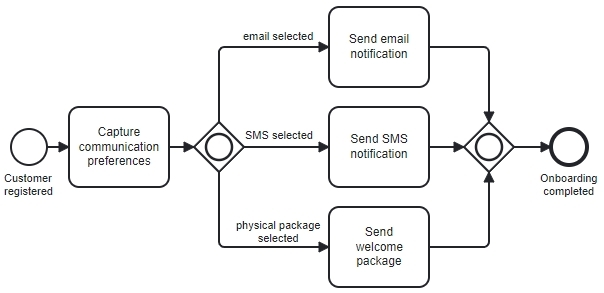
- Email Notification – sent if customer opted for email
- SMS Notification – sent if customer opted for SMS
- Welcome Package – sent if customer requested a physical package
Explanation: One, two, or all paths may be activated depending on customer preferences.
Key characteristics
✔ Multiple paths may be activated
✔ Gateway synchronizes only active paths
✔ More flexible but harder to understand
Visual Comparison
| Feature | Exclusive | Parallel | Inclusive |
|---|---|---|---|
| Paths taken | Exactly one | All paths | One or more |
| Synchronization | No waiting | Wait for all | Wait for active paths |
| Complexity | Low | Low | Medium |
| Typical use | Exclusive options | Parallel tasks | Optional parallel tasks |
When Should You Use Each Gateway?
Use Exclusive Gateway when
- Only one outcome is possible
- You model decisions
- Conditions are mutually exclusive
Business examples:
- Loan approved vs rejected
- Customer type A vs B
- Payment successful vs failed
Use Parallel Gateway when
- Activities can run simultaneously
- Order does not matter
- All Tasks must finish before continuing
Business examples:
- Multiple departmental approvals for a project
- Parallel document checks in legal or compliance
- Synchronizing data updates across multiple systems
Use Inclusive Gateway when
- Several optional actions may happen
- Multiple conditions can be true
- Not all paths must execute
Business examples:
- Multi-channel notifications for onboarding
- Optional compliance checks based on location
- Conditional service activations for premium customers
Common Modeling Mistakes
1️⃣ Using Exclusive instead of Parallel
Incorrect:
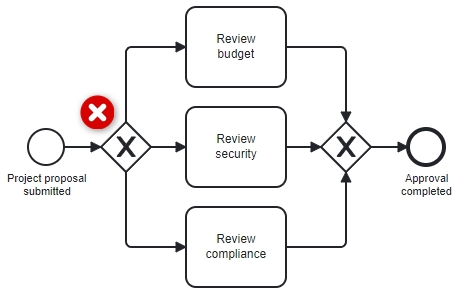
Problem: The Exclusive Gateway allows only one review to happen, while the process requires all reviews, leading to incomplete approval.
Correct:
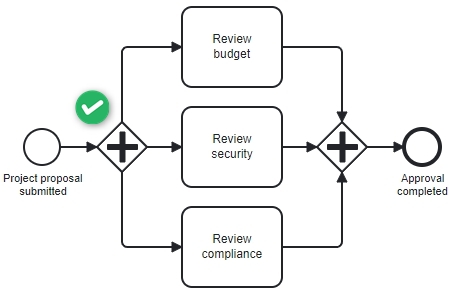
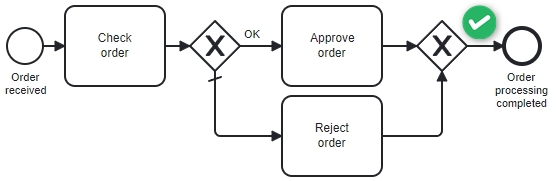
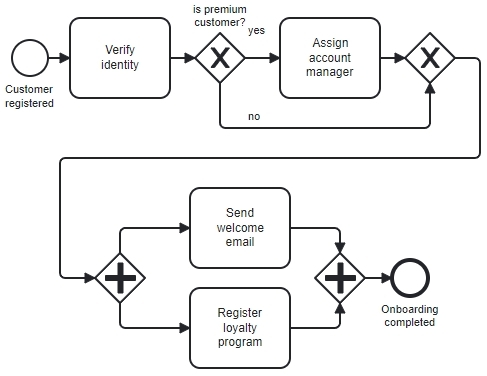
2️⃣ Merging Parallel Gateway After an Exclusive Split
Incorrect:
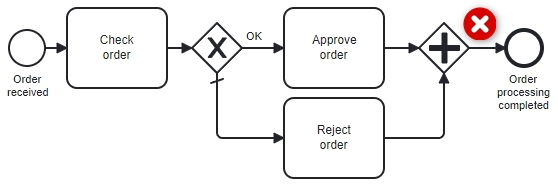
Problem: The parallel gateway waits for multiple paths, but only one path was activated, causing the process to get stuck.
Correct:
3️⃣ Forgetting the Parallel Join
Incorrect:
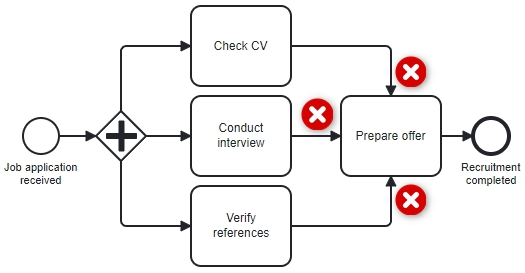
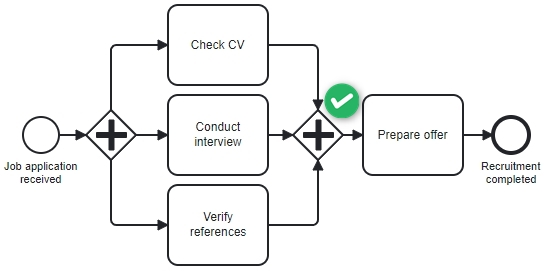
Problem: Parallel Tasks are merged directly into a Task instead of a Parallel Gateway, so the last Task may start too early and execute 3 times.
Correct:
4️⃣ Overusing Inclusive Gateways
Inclusive gateways are powerful but can make diagrams hard to read and maintain. Often, the logic can be simplified with Exclusive + Parallel combinations.
Inclusive Gateway overuse - hard to read:
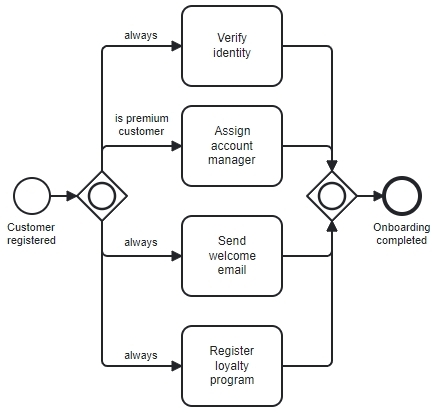
The diagram works technically, but using a single Inclusive Gateway for all Tasks makes it confusing and hard to understand or maintain.
Inclusive Gateway corrected - Simple & Clear:
Quick Decision Guide
If you ask yourself:
- “Which option should we choose?” → Exclusive
- “Which Tasks can run at the same time?” → Parallel
- “Which optional actions should be executed?” → Inclusive
FAQ
What is the main difference between Exclusive and Inclusive gateways?
An Exclusive Gateway selects exactly one path, while an Inclusive Gateway can activate multiple paths if several conditions are true.
Do Exclusive gateways need a merge gateway?
Not always. If the branches are mutually exclusive, BPMN allows them to reconnect without an explicit gateway, although adding one often improves readability (more details: Do I need a merging Exclusive Gateway in BPMN?).
Does a Parallel Gateway always need a matching join?
Usually yes. If you split the flow with a Parallel Gateway, the corresponding join ensures the process waits for all branches to finish.
Why is the Inclusive Gateway harder to understand?
Because it must track which branches were activated earlier and wait only for those tokens. This makes its synchronization logic more complex than XOR or AND gateways (more details: Mysteries of the BPMN Inclusive Gateway).
Final Thoughts
Exclusive, Parallel, and Inclusive Gateways form the foundation of process control in BPMN. Understanding their differences helps you create diagrams that are:
- logically correct
- easier to understand
- executable by BPM systems
Most processes can be modeled using only these three Gateway types. Mastering them is therefore one of the most important skills for any BPMN modeler.
✅ Pro tip: If your Gateway logic becomes difficult to explain in one sentence, your model probably needs simplification.
Why Trust This Article?
This article was written by Filip Stachecki, a business process modeling expert with more than 20 years of experience in business analysis, process improvement, and BPMN. Filip has been involved in OMG certification programs since 2013 and is one of the co-authors of the OMG BPM 2 (OCEB 2) certification exams. Through eduMAX, he has helped professionals from dozens of countries prepare for BPMN certifications and apply process modeling standards in real-world business environments.
About eduMAX
eduMAX is an OMG-focused training provider specializing in BPMN, UML, and SysML certification preparation. The company offers online courses, practice exams, and instructor-led training designed to help professionals successfully prepare for OMG certification exams and apply modeling standards in real-world projects.